The VMT debacle in San Diego County
Every now and then, a public policy is so spectacularly misguided that you almost have to step back, clap slowly, and admire it—not for what it accomplishes, but for how thoroughly it manages to sabotage the very thing it claims to help. San Diego County’s adoption of Vehicle-Miles-Traveled (VMT) requirements is one such masterpiece. In a region where the affordable‐housing crisis has been the center of the public discussion and outrage for the last decade, it is deeply frustrating to see yet another well-intentioned policy morph into a barrier for development, and the politicians still don’t get it! The adoption of the VMT handcuffs in San Diego County in June of 2020 is exactly that: in its current form, utterly counter-productive to building homes and providing housing for families in this region.
The recent piece from Voice of San Diego (https://voiceofsandiego.org/2025/11/20/county-official-one-policy-not-clearly-to-blame-for-homebuilding-drop/) acknowledges that “developers have claimed … the VMT policy … forced by state law has halted homebuilding in unincorporated areas”. Evidence of housing starts shown by Supervisor Desmond is a direct confirmation of this! Based on his chart of building activity in the San Diego County unincorporated areas, comparing it tothe National, West Region, California, and County of San Diego as a whole, the former is the only one that reversed its upward course in 2020 dropping to the levels of the mid-1990s.
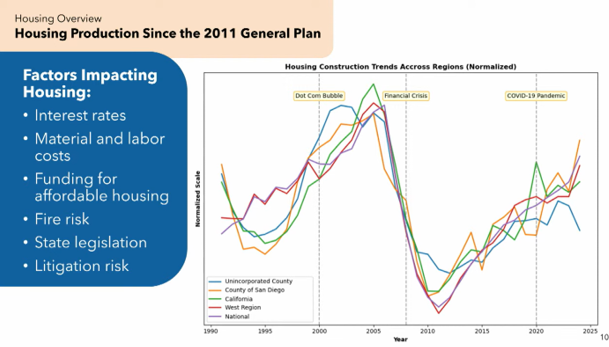
The county officials in denial responded by saying it’s “challenging to isolate any one factor” for the drop in homebuilding, you need to look at interest rates, labor and material costs, fire risks, legislation and litigation risks, but the picture is clear – with all these factors in play for all areas, only unincorporated areas of San Diego dropped like a rock, and the only factor that the other player don’t have to deal with is VMT. Fair enough, it’s rarely just one cause, but VMT is not just one cause, it’s just one of the pieces in decades of anti-building policies that California is known for, and it is a major policy that deserves sharper criticism, or at least deep analysis.
A policy designed as a choke-point, not a facilitator
For years the environmental activists (you know the types – liberals, Prius drivers, single, they-them, Starbucks afficionados, no pets, no kids, UCSD graduates with some arts degree, life-long renters, complainers, self-righteous climate activists) were pushing for finding ways to stop housing developments in the unincorporated areas of California, claiming that men and coastal sage brush are enemies and we can’t live next to each other. They called it “Suburban sprawl” while forgetting that Rancho Bernardo, Poway, and Scripps Ranch at one point were nothing more than a wide open space with bunnies and butterflies, and now, thanks to this “sprawl,” they are some of the best neighborhoods of our beautiful San Diego!
So, when somebody at the state came up with the new measurement to evaluate the development projects through the prism of how many car trips they will generate from home to work and back, environmentalists felt like they had just found the new universal vaccine. Here comes VMT, the new law that measures how efficient or “non-efficient” the proposed subdivision is in terms of Vehicle Miles Travelled, and as a result, how much emissions these trips generate.
The further away you are from “employment centers” or your local shopping, the worse off you are in VMT points, and the less likely your development will be approved. OR, if you really want your 40-home project approved in a VMT non-efficient area (let’s say Fallbrook), you could mitigate it by designing and building the whole public bus route (and provide buses and drivers too!) with all the stops and roadways all the way to urban Escondido at a cost of, say, $150 mln. Doable, right?
The environmental lobby would rather see San Diego as a community of 70-story apartment projects in Clairemont Mesa or Logan Heights, or 12 ADUs on a 5000 s.f. lot in Normal Heights, that promote no children, no pets, no family society, but not a subdivision of detached homes for families on 15,000 s.f. lots in Fallbrook with a pool and room for kids to play outside, which is what families with kids and dogs, and extended families want to see more, even if the developer designates 30% of land for park, walking trails, natural preserve or any other set asides.
Instead of looking for ways to enable, or at least not to impede housing developments in unincorporated zones, the County deployed a highly conservative VMT threshold that many in the development community consider unrealistic, they pretty much eliminated any opportunities for housing community developments in the future for areas like Fallbrook, Bonsall, Ramona, Valley Center, Alpine, North Vista and Escondido, and other unincorporated areas where the land is plentiful, but you can’t touch it!
Using 2016 Driving Data in 2025—Because Who Doesn’t Love Ancient History?
The VMT framework relies on maps and assumptions that, in many respects, are outdated. For example, the County’s Transportation Study Guide is based on standards that trace back to older travel models and assumptions before the dramatic shift in remote employment, hybrid work and vehicle behavior triggered by the pandemic. Add to that the rising adoption of electric vehicles (which generate fewer tailpipe emissions), and the policy simply fails to keep pace with reality: by some estimates, EVs are now responsible for 30-35% of all driving, a drastic change that happened in the last 10 years, i.e. the years that VMT doesn’t even take into account, because it is modeled on a 2016 snapshot via San Diego Association of Governments (SANDAG) data that doesn’t reflect today’s commuting patterns. As a result, building in certain unincorporated zones is penalized for supposed “extra travel” that in many cases may no longer occur, because if you design your policy based on 2016 commuting patterns, you sharply handicap housing in 2025.
Remote work alone blew up the entire logic behind traditional commute-radius assumptions. Yet San Diego insists on using pre-pandemic models to justify blocking housing today—because nothing says “forward-thinking planning” like a decade-old map and a refusal to update your homework.
A local policy choice that deliberately went “conservative”
The state of California came up with the VMT requirement to meet its overall environmental dream (you know, no people, no homes, no cars, no emissions, just protected birds, plans, and politicians), but left it up to individual counties to set the thresholds. The County could have adopted a more flexible implementation of the state’s VMT requirement. But what the Board of Supervisors under Nathan Fletcher approved was the most restrictive interpretation in the entire state, setting the County’s thresholds much lower (meaning fewer units allowed before triggering full VMT analysis/mitigation) than nearby jurisdictions, just 11 detached units or 15 attached units. Meanwhile, in Riverside County, the numbers cited are 110 detached units (and 150 attached) before VMT kicks in.
Nathan Fletcher (former Chair of the County Board of Supervisors) pushed a democratically lop-sided Board of Supervisors to adopt the new draconian VMT guidelines, arguing that they were an unavoidable mandate of state law, and claiming that “we have to do both” (housing + climate). He personally shepherded this VMT straitjacket through the County, and was determined to prove he could out-conservative anyone on climate optics—even if it meant kneecapping the region’s housing pipeline along the way.
Flether’s years in the office were some of the worst for policymaking in the County when it comes to the housing and building industry. Whether by design or neglect, the result is clear: the County made a policy choice that limited development, under the guise of solving the climate crisis, while completely neglecting, or even worsening the region’s housing crisis. The policy was not just passive or “following state law”—it was set up to curtail local development aggressively.
His VMT posture was always more about image than impact. He wanted to be the guy who “took a strong stand” on climate… even if it meant taking an equally strong stand against housing in the process. The building industry? The families who need homes? The middle class trying to stay in San Diego? Collateral damage.
The Great San Diego Housing Mystery: Why Aren’t Developers Building?
Drive just one hour north to Riverside County, and you see a completely different picture:
Riverside: Booming housing construction, reasonable housing prices, builders expanding, young families buying homes.
San Diego: near-zero production, sky-high prices, builders sidelined, Middle class squeezed out.
The difference is policy. VMT regime is not just a check-the-box environmental policy. For the building industry and for families seeking homes, it’s a regulatory brake.
A couple of years after the VMT implementation, the county realized that VMT just killed all substantial developments in unincorporated areas of San Diego, which meant the county all of a sudden would not be getting any building fees for permits, plan checks, impact fees, etc. Big national builders started leaving San Diego, because they couldn’t sustain future activities; they are finishing up what they already have and concentrating on other areas with sustainable land supply.
So, in 2022, Fletcher came up with another genius idea: let’s allow developers to buy their way out of VMT compliance with mitigation fees of $30,000 to $500,000 per unit for VMT compliance. Builders didn’t buy it, because these fees would have to be passed on to the ultimate buyers, and the homes would be utterly unaffordable. These sorts of costs kill mid-scale development before it starts.
The good news is that the Court of Appeal recently found the County’s infill and “small-project” screening thresholds lacked “substantial evidence” for San Diego’s context and opened the door to use the 2011 General plan exemption for some of the projects.
Climate Goals and Housing Goals Should Work Together—Not Destroy Each Other
Here’s the thing: builders aren’t anti-climate. Mobility planning isn’t the enemy. But VMT, as implemented in San Diego, is the worst of both worlds:
- It punishes modest, infill-adjacent development.
- It blocks smaller rural projects that could be workforce housing.
- It increases housing scarcity, pushing families farther from job centers.
- It actively increases long-distance driving by forcing workers to Riverside or Imperial County or even Tijuana.
Nothing says “sustainable climate planning” like exporting your workforce to another county and making them drive 80 miles a day.
County of San Diego planning staff now say they expect to explore alternative methods, such as exemptions for infill or “general plan village” areas. But for thousands of families now priced out, and for developers pulling back, this feels like too little, too late. When policy kills housing for half a decade, the cost is real: lost opportunity, lost workforce housing, lost affordability.
By the way, the county also felt the pain of its own policy: with VMT in place, the County of San Diego has no way of meeting the State’s mandate for delivering new housing units and combating the housing crisis, which means that there will be penalties and there will be real consequences for the County from the State. This is what you get when different heads work on opposing problems without consulting each other and without any clue how one policy is going to affect the other. Welcome to California!
If policymakers want to understand the falloff in homebuilding in San Diego’s unincorporated county, they should stop pretending that the VMT regime is benign background noise. It is a heavy, blunt 100% anti-development political instrument that already ruined new housing construction in unincorporated areas. This policy prioritized climate optics over delivering homes for families. The building industry deserves better. The people of San Diego deserve better.
What should be done instead?
- Re‐examine the baseline assumptions underlying VMT: update travel-behavior models to reflect remote work, EV adoption, post-Covid commuting trends.
- Raise the exemption threshold for unincorporated small-scale developments so that typical detached home subdivisions are not penalized if they meet basic design/transport criteria.
- Develop a tiered compliance/mitigation schedule that rewards smaller infill, starter-home, and family-oriented projects rather than punishes them.
- Rebalance the cost burden: if we truly have a housing crisis, then regulatory policy should favor facilitating rather than freezing development; climate goals should integrate with housing goals—not oppose them.
- Admit the policy is broken. Stop Denial! If VMT weren’t a massive obstacle, we wouldn’t all be talking about it.
Major VMT milestones:
1. June 24, 2020 – Initial Adoption of the Transportation Study Guide (TSG)
In June 2020, the San Diego County Board of Supervisors adopted its first Transportation Study Guide, implementing the state’s SB 743 VMT framework for unincorporated communities. This version set highly conservative thresholds that triggered VMT analysis for anything over roughly 10 detached or 15 attached homes, relying heavily on older 2016 SANDAG travel data and offering very limited exemptions. While intended to comply with state law, the 2020 TSG created extremely restrictive conditions for rural and semi-rural development, immediately raising concerns among builders that it would halt most new housing in unincorporated areas—and it largely did.
2. September 2021 – Rescission of the 2020 Guide for Overhaul
In September 2021, the Board voted 4–0 to rescind the 2020 Transportation Study Guide after widespread criticism from the building industry, planning professionals, and community groups. The Board directed staff to overhaul the VMT program to better align with state guidance and to address the fact that the existing thresholds were effectively freezing development. This move acknowledged that the 2020 TSG was overly rigid and unworkable, and it opened the door for revisions focused on infill incentives and more reasonable VMT screening rules. It was essentially the County admitting: “The 2020 version isn’t functioning the way it should.”
3. September 28, 2022 – Adoption of the Revised TSG with New Thresholds
The September 2022 revision attempted to fix the problems by revising VMT screening criteria and creating new categories like “VMT-efficient areas,” “infill opportunity areas,” and “screening maps.” It also introduced updated methodologies and mitigation strategies aimed at balancing climate goals with housing production. However, despite added flexibility on paper, the 2022 revisions still relied on the same outdated regional travel data and preserved extraordinarily low thresholds for small projects. Builders argued that the revised TSG remained overly conservative and continued to block the vast majority of feasible subdivisions in unincorporated San Diego County.
4. April 2025 – Court of Appeal Invalidates Key Portions of the TSG
In April 2025, the Fourth District Court of Appeal struck down the County’s “infill” and “small project” screening thresholds, ruling that they lacked substantial evidence and were not properly supported by local travel data or rational analysis. The Court concluded that the County’s VMT criteria were not just restrictive—they were legally deficient. This ruling forced the County back to the drawing board, effectively confirming what the development community had been warning for years: the County adopted VMT rules that were excessively conservative, based on outdated assumptions, and inconsistent with both state law and sound planning practice.
What will be next? Time will tell.
Alex Lisnevsky