One of the best strategies for today’s investors and developers in California is to find vacant lots and subdivide them into smaller lots that can be built on or sold off as individual lots. Normally, it would require a lengthy legally challenging process of obtaining a subdivision parcel map, which in most jurisdictions in California, would normally take between two to five years or longer, cost hundreds of thousands of dollars, require costly engineering submissions, environmental and other clearances, fights with NIMBY groups, special interest groups and anybody who has extra time to go to city hearings to tell their sob story why you should never be allowed to subdivide this lot, without any guarantee that you can actually finish the process. But with the passage of SB 684 and SB1123, there appeared some hope for land owners to bring some sense into this bureaucratic insanity.
Let’s look at what these Senate Bills are, how they are different, and how they can help you achieve previously impossible – subdividing infill lots. Here’s a comparison of California Senate Bill 684 (“SB 684”) and California Senate Bill 1123 (“SB 1123”) — including what changed, and how they apply (including in places like City of San Diego / San Diego County.
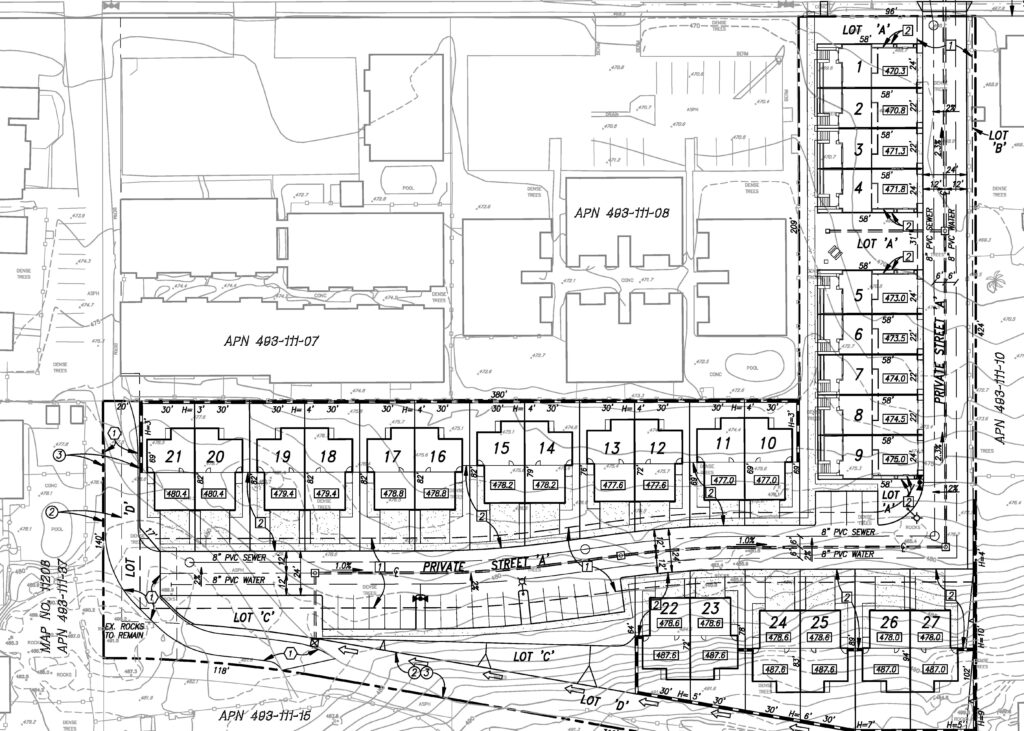
What SB 684 and SB 1123 are (and how they’re related)
- SB 684 was enacted in 2023 (effective July 1, 2024) and implemented a streamlined, ministerial approval process for small-lot subdivisions and housing developments (up to 10 parcels / 10 dwelling units) on lots zoned for multifamily residential use.
- SB 1123 (signed 2024, effective July 1, 2025) is an amendment/expansion of SB 684. It extends SB 684’s streamlined process to vacant lots in single-family zoning districts, under certain conditions — thereby broadening the types of parcels eligible for the small-lot subdivision rules.
In short, SB 1123 builds on SB 684. If SB 684 enabled small-lot subdivision in multifamily zones, SB 1123 allows similar subdivisions in some single-family zones (vacant lots) and adds refinements/clarifications.
Key Provisions & Eligibility Differences
Here’s a breakdown of what each law allows, and how they differ (especially after the SB 1123 amendments):
| Feature | SB 684 (pre-2025) | SB 1123 (post-amendment) |
| Eligible base zoning | Multifamily residential zones only | Adds vacant lots in single-family residential zones, under specified conditions (e.g. lot ≤ 1.5 acres, vacant, surrounded by urban uses) |
| Maximum number of parcels / units | Up to 10 parcels / 10 dwelling units | Same cap: up to 10 parcels / 10 units |
| Minimum parcel size (after split) | 600 sq ft (in multifamily zones) | For single-family-zoned vacant lots: minimum 1,200 sq ft per parcel; for multifamily-zoned splits, still 600 sq ft. |
| Environmental / discretionary review (e.g. public hearings, CEQA, appeals) | Skipped — ministerial approval (no discretionary review / CEQA / public hearing) | Same — the streamlined, ministerial process remains, now extended to eligible SF-zoned vacant lots. |
| Ownership models allowed | Density requirement (when site is not in housing element inventory) | SB 1123 clarifies/expands to allow tenancy-in-common (TIC) as an ownership structure, adding flexibility. |
| Density requirement (when site not in housing element inventory) | Must meet “maximum allowable residential density” under zoning. | SB 1123 relaxes this: only requires at least 66% of the maximum allowable density (or 66% of applicable statutory density), whichever is greater. |
| Setbacks, parking, frontage requirements, etc. | Law prohibits local agencies from imposing discretionary design standards that would preclude allowable density — e.g. they cannot require bigger setbacks, enclosed parking, or reduce allowable floor area ratio (FAR) below certain thresholds. | SB 1123 keeps those protections. It also prohibits requiring minimum frontage (on parcels) and continues the restrictions on parking/ setback rules for qualifying projects. |
What This Means for San Diego (and Homeowners / Developers There)
Because the streamlined-subdivision rules under SB 684 / SB 1123 apply statewide (to cities including San Diego) — they provide a new pathway for more housing development, especially infill / small-lot subdivisions.
- For multifamily-zoned parcels: SB 684 already allowed developers/homeowners to split into up to 10 lots/units, with minimal regulatory friction.
- As of July 1, 2025, SB 1123 means vacant single-family-zoned lots might qualify, which opens potential for increased density even in neighborhoods zoned single-family (if zoning, lot size, vacancy status, and surroundings meet criteria).
- The streamlined process — no discretionary review, no CEQA, no public hearings — means potentially faster, less uncertain approvals. In San Diego’s regulatory context, that can make small-scale infill projects more viable, particularly for “starter-home” or affordable housing efforts.
However, eligibility is not automatic. The parcel must meet many requirements (size, zoning type, “vacant” status if SF zone, being surrounded by urban uses, environmental hazard exclusions, etc.) for the streamlined process to apply.
Why SB 1123 Matters: What Changed vs. SB 684
The adoption of SB 1123 significantly broadened the reach and flexibility of small-lot subdivision law in California. Key changes/advantages:
- Extending small-lot subdivision rights to single-family zoned vacant lots (not just multifamily zones).
- Allowing more flexible ownership models (e.g. tenancy in common) — which can help make housing more affordable or accessible for shared-ownership models.
- Reducing the required density threshold (for non-housing-element parcels) — requiring only 66% of maximum density instead of 100%. This makes it easier to design developments that comply and get approved.
In effect, SB 1123 makes it easier (more broadly) to build small-lot homes/subdivisions — lowering barriers, increasing potential supply of small (starter) homes, perhaps especially in places like San Diego that face housing supply constraints.