Background: AB 1674 was introduced on February 2, 2026, would require local governments to make certain housing applicants in food deserts or areas “at risk” of becoming food deserts show they are not reducing “site capacity” for a large grocery store, and if they are, to provide equivalent mitigation such as reserved space/infrastructure or contributions to a replacement-store fund. The bill defines a “large grocery store” as 15,000+ square feet and lists required capacity features like loading docks, parking ratios, and refrigeration/utilities infrastructure. It passed the Assembly Agriculture Committee 5-0 on March 25, 2026, was re-referred to Housing and Community Development, and a hearing set for April 7 was canceled at the author’s request. Industry groups including CAA and CBIA have argued the bill’s “at risk” language is too vague and could create more uncertainty, costs, and even denials.
Just when you thought California had run out of ways to make housing harder to build, Sacramento has once again risen to the occasion. Enter AB 1674, the latest legislative love letter to the fantasy that private developers are not merely builders of housing, but a sort of secular clergy charged with solving every social problem the state itself has failed to fix. Housing shortage? Developers. Climate policy? Developers. Transportation impacts? Developers. School overcrowding? Developers. And now, apparently, food insecurity and grocery-retail logistics too.
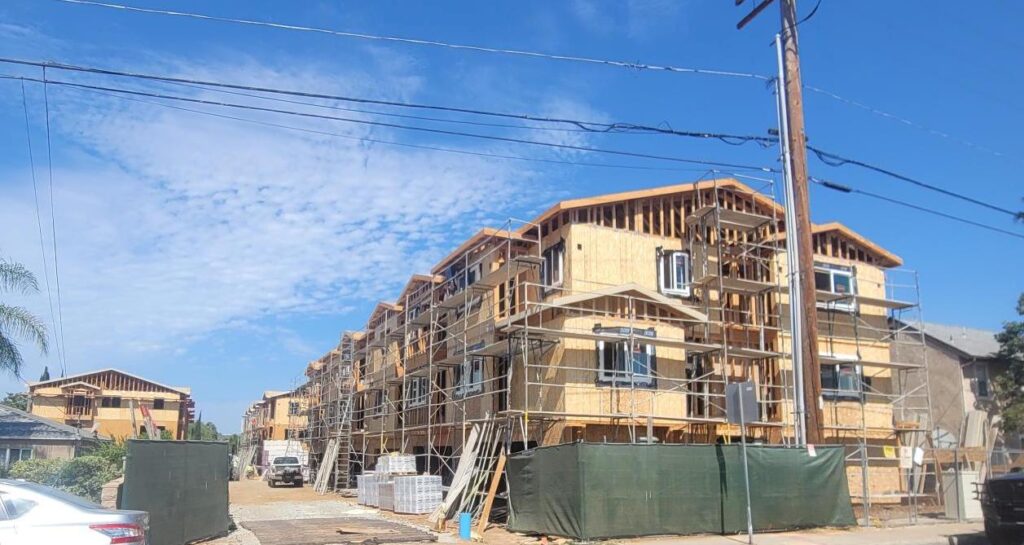
Under AB 1674, if a housing project is proposed in a “food desert,” or worse, in an area that might someday become one, the developer may have to prove the project does not reduce the site’s capacity for a full-size grocery store. If it does, the builder may need to reserve equivalent space and infrastructure for a future store or pay into a fund to support grocery development within a half-mile. This is not satire. The bill says it out loud. It applies to apartments, townhomes, condominiums, and mobile homes, and it defines grocery-store “site capacity” with all the delightful specificity only Sacramento can produce: loading bays, truck access, parking ratios, refrigeration-ready utilities, and the rest of the physical anatomy of a supermarket.
So now the California developer’s job description reads something like this: buy overpriced land, navigate CEQA, fight VMT thresholds, absorb school fees, negotiate inclusionary requirements, subsidize deed-restricted affordability, carry financing costs through endless entitlement delays, satisfy labor and energy mandates, and then, before anyone hands over a permit, please also confirm whether this parcel could have hosted a 15,000-square-foot grocery store with pallet-jack-ready docks and four parking spaces per 1,000 square feet. Because nothing says “housing affordability” like forcing a multifamily developer to moonlight as a supermarket site planner.
And that is the real California genius here: the state keeps declaring housing a crisis while simultaneously treating every housing proposal as a convenient delivery vehicle for unrelated policy ambitions. Sacramento talks like it wants units. It legislates like it wants penance. Build housing, yes, but only after your project has been ritually transformed into a jobs program, a climate intervention, a social-equity instrument, a transportation offset machine, an affordable-housing subsidy platform, and now a grocery preservation strategy. At some point one has to ask: are developers expected to build homes, or perform miracles?
This is where the “equity and inclusion” language becomes less a principle than a magic wand. The moment a bill is wrapped in equity vocabulary, the ordinary rules of economic gravity no longer seem to apply. Costs are no longer costs; they are moral obligations. Delays are no longer delays; they are community-sensitive process. Vagueness is no longer vagueness; it is local flexibility. And if a project dies under the weight of all this compassion, well, apparently the problem was never the policy stack. The problem was that greedy builders failed to care hard enough.
AB 1674 is especially revealing because it shows how casually California lawmakers now treat feasibility as a nuisance detail. The bill does not merely create a grant program to support food access. That alone would be a conventional public-policy response. Instead, it reaches for the usual Sacramento shortcut: force the housing producer to internalize yet another public-policy objective. The state even creates a Food Desert Elimination Grant Program and a California Equitable Food Access Account, which sounds noble enough, except for the small question of why the Legislature keeps acting as though the cleanest funding source for every new social mission is whichever private project is unlucky enough to file an application this month.
Supporters will argue, not entirely irrationally, that grocery stores matter, food access matters, and some redevelopment can displace neighborhood-serving retail. True enough. But even good intentions can be weaponized by bad legislative design. The industry’s core objection is not that groceries are unimportant. It is that the bill hands local governments a vague new standard, including areas merely “at risk” of becoming food deserts, and then invites them to impose mitigation or potentially derail projects if the developer cannot satisfy an open-ended burden of proof. CAA and CBIA warned exactly that in opposition: more discretion, more inconsistency, more cost, more uncertainty, and more opportunities for projects to stall or die. In California housing, uncertainty is not a side effect. It is a cost multiplier.
And that is the part legislators never seem eager to say out loud. Every additional mandate does not land on some abstract villain called “the developer.” It lands on the deal. On the capital stack. On the loan sizing. On the land residual. On the number of units that pencil. On whether a project survives first review. On whether an investor funds the next one. On whether a builder chooses California at all. Political speeches can ignore pro formas. Lenders do not.
This is the broader disease in California housing policy: lawmakers behave as if housing production is infinitely elastic. Need more affordability? Add a mandate. Need more labor standards? Add a mandate. Need greener buildings? Add a mandate. Need more local retail protection? Add a mandate. Need more process, more reporting, more mitigation, more public benefits? Add all of it. Somehow, in the official imagination, rent levels must remain “affordable,” returns must remain modest, projects must remain financeable, and builders must remain cheerful. The developer, apparently, is a hybrid creature: part capitalist when it is time to absorb risk, part philanthropist when it is time to absorb policy, and part saint when it is time to keep going anyway.
The irony is that California already has plenty of precedent for requiring developers to mitigate transportation impacts, school impacts, affordable housing obligations, and environmental impacts. AB 1674 fits neatly into that tradition, which is precisely why it alarms the building industry. Each new requirement may look manageable in isolation. In aggregate, they become a slow legislative mugging. No single straw breaks the camel’s back. California just keeps sending over more straw with a press release about justice.
And here is the punchline nobody in Sacramento seems to enjoy: if you make housing harder to build, you do not get more equitable communities. You get fewer projects, fewer units, higher rents, less competition, and a market tilted even more toward the largest, best-capitalized players who can endure uncertainty. Small and midsize builders, the very people who often produce incremental housing in ordinary communities, get pushed out first. So the state may yet discover that in trying to legislate grocery access through housing mandates, it has once again succeeded mainly in restricting housing.
AB 1674 may still change; its April 7 hearing in Housing and Community Development was canceled at the author’s request, so the measure is not finished moving through the process. But the bill is already a perfect symbol of the California governing instinct. When a public problem exists, do not first ask whether the state should solve it directly. Ask instead which private industry can be saddled with another obligation while officials congratulate themselves for being inclusive.
How many more policies can California Democrats drop on builders and still expect housing to get built? Apparently, we are about to find out. Sacramento seems convinced that developers can finance affordability, subsidize infrastructure, absorb regulatory delay, preserve neighborhood retail, satisfy every equity metric, and still deliver abundant housing at politically acceptable prices. That is not a housing strategy. That is a messiah complex, outsourced to the private sector.
By Alex Lisnevsky